
Managing a workforce in the modern era is more complex than ever. Between hiring, payroll, regulatory compliance, tax reporting and cross-border expansion, HR has become a core strategic function rather than an administrative afterthought.
If you’ve been researching global expansion or scalable HR support, you’ve likely seen the term ‘PEO’ come up. In this article, we’ll outline what a PEO is, how the concept works and whether one would be a good fit for your business.
What Does PEO Stand For?
PEO stands for Professional Employer Organisation.
A PEO is a company that partners with businesses to provide outsourced HR services. PEOs operate through a co-employment model, where they share certain management responsibilities with your business.
It is important to note that the PEO model is more common in the United States. In Australia and many other jurisdictions, businesses may instead engage managed payroll providers, HR advisory services or Employer of Record (EOR) solutions, depending on their structure and expansion goals.
It’s important not to confuse a PEO with other HR partners, such as a recruitment agency, a staffing firm or a payroll processor. Instead, a PEO provides broader support across a wide range of HR services, while you maintain control over your workforce.
What is a PEO in HR? The Core Functions
A PEO supports businesses by managing key HR pillars, allowing internal teams to focus on strategy, culture and performance instead of admin.
Within HR, a PEO carries out a number of core functions designed to improve operational efficiency while helping ensure employees are managed in line with applicable employment legislation.

Payroll & Tax Administration:
One of the primary functions of a PEO is managing payroll processing and tax reporting.
Rather than replacing your internal team, a PEO works in partnership with them to reduce admin and compliance risks. PEOs typically handle:
- Salary and wage calculations
- PAYG withholding and tax remittance
- Superannuation administration
- Payroll reporting in accordance with local regulations
- Record-keeping and payslip compliance
Ensuring payroll accuracy is crucial, especially for businesses scaling into new markets. Many organisations choose to engage a PEO to simplify ongoing payroll obligations and avoid costly mistakes.
Regulatory Compliance
Employment legislation changes regularly, regardless of the jurisdiction. In Australia, for example, Fair Work regulations and Modern Awards impose detailed obligations around pay rates, classifications, leave entitlements and termination processes.
To reduce legal exposure and administrative pressure for expanding businesses, a PEO monitors these changes and helps ensure:
- Employment contracts align with local legislation
- Award classifications are correct
- Leave entitlements meet statutory requirements
- Workplace policies remain compliant
Risk Mitigation
- Workers’ compensation administration
- Employer liability coverage
- Workplace health and safety frameworks
- HR documentation and policy compliance
Employee Benefits
- Private health cover and other voluntary employee benefits (where applicable)
- Workers’ compensation premiums
- Retirement fund arrangements
- Other employee benefit schemes
What Employers still control
Importantly, partnering with a PEO does not mean surrendering daily management of your staff. Your business retains authority over:
- Hiring and termination decisions
- Day-to-day management
- Performance oversight
- Company culture
- Strategic direction
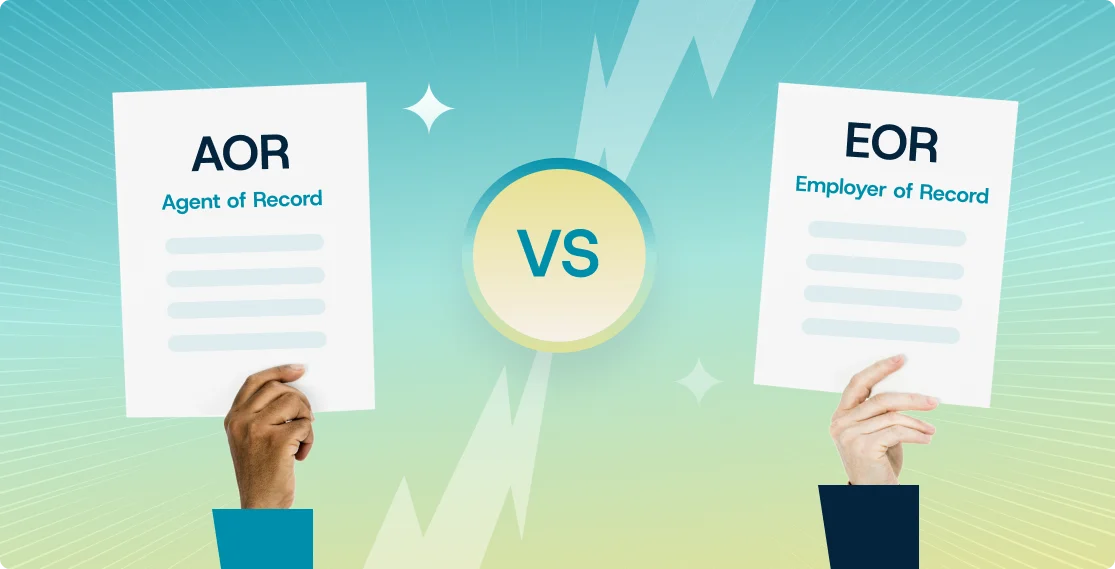
PEO vs EOR: What is the Difference?
Those familiar with outsourcing HR services may have prior knowledge of an Employer of Record (EOR). An EOR becomes the legal employer of your staff, assuming responsibility for payroll, tax, employment contracts and statutory compliance, while you retain day-to-day management of the employee’s work.
If you have started to compare the two, you may be wondering what the difference is between a PEO and an EOR, given that the roles and responsibilities of both roles seem markedly similar.
The core difference between a PEO and an EOR lies in the legal employment structure and who is ultimately liable for the employer. Below is a simplified comparison:
| Feature | PEO (Professional Employer Organisation) | EOR (Employer of Record) |
|---|---|---|
| Legal Employer | Shared co-employment model | EOR is the legal employer |
| Local Entity Required | Yes your business must have a registered entity |
No EOR provides the local entity |
| Payroll & Compliance | Managed jointly | Fully managed by EOR |
| Expansion Use Case | Businesses with existing local presence | Businesses entering new markets without setting up an entity |
| Risk Liability | Shared | Primarily held by EOR |
There are several scenarios that your business may fit into, which can help you choose between an EOR and a PEO.
Your business may be better suited to an EOR if you are:
- Expanding internationally for the first time
- Testing new markets
- Hiring quickly in multiple jurisdictions
A PEO, meanwhile, may better suit businesses that:
- Already have a registered entity in the country
- Want administrative HR support
- Need help managing complex compliance requirements
Key Benefits: Why Partner with a PEO?
For expanding businesses, there are numerous operational and strategic advantages of engaging a PEO.

Structured Support for Established Global Operations
While a PEO requires you to have a local entity already established, it can remove many of the usual administrative barriers once you’re established.
Instead of building an in-house HR team from scratch, you gain access to a structured people management system and compliance support from experienced specialists.
Securing and Retaining Top-Tier Global Talent
The ability to offer compliant employment contracts and competitive benefits allows your business to attract high-quality candidates, regardless of the location.
A structured HR partnership ensures employees receive timely pay, correct entitlements and secure benefits. This level of support at the employee level strengthens engagement and ultimately strengthens retention.
Eliminating the Cost and Complexity of Offshore Hiring
Establishing a foreign subsidiary can involve legal registration fees, ongoing accounting and tax compliance requirements, setting up a physical office and appointing local directors or representatives.
A PEO reduces internal HR overhead once an entity exists, streamlining compliance, payroll and workforce administration while your business expands.
Empowering the Modern Employee Experience
Today’s workforce values flexibility and opportunity on a global scale. Structured employment solutions, such as PEOs, enable employees to pursue new roles without being restricted by their location.

Future-Proofing Your Workforce with EPG Group
Understanding what a PEO is helps you choose the right model for your business as you plan your global expansion.
Whether you need HR support under a co-employment model or a fully managed EOR solution to enter a new market, structured employment solutions reduce risk, improve operational efficiency and support sustainable growth.
EPG Group combines payroll, staffing, migration and workforce compliance expertise into one integrated model, supporting businesses globally.
If you’re planning your next stage of expansion, get in touch with us to explore the right solution for your business strategy.